“Foundation of Trust. Built on Quality”
Integrated Excellence for Evolving Business Ecosystems
Organisations no longer compete as isolated entities. They operate within interconnected ecosystems shaped by customers, suppliers, technology, regulation, people, markets, sustainability expectations and risk. The quality of performance increasingly depends on how well these moving parts are understood, aligned and managed as one system.
At Quality Foundation, we view excellence as more than compliance or the implementation of individual improvement tools. It is the ability to see the organisation as an integrated whole, recognise the issues that influence performance, choose the right response, build the required capability and sustain improvement over time.
Our work brings together assessment, consulting and training through research-grounded frameworks that connect strategy with execution, risk with opportunity, systems with people, and operational discipline with long-term value creation.
The result is a more resilient, responsive and capable organisation—better prepared not only to manage today’s challenges, but to evolve with the business ecosystem around it.

The WRRD Model: Seeing the Issue Before Choosing the Response
Most organisations do not suffer from a shortage of initiatives. They suffer from a shortage of clarity. Problems are often treated too quickly as “process gaps,” “people issues,” or “risks” without first understanding what kind of issue is actually present. The result is familiar: corrective actions that do not last, training that does not change behaviour, controls that add complexity, and improvement programmes that address symptoms rather than causes.
The WRRD model — Weakness, Rationality Limits, Risk and Dissatisfaction — provides a structured way to interpret organisational reality before action is taken. In the orientation–performance model, Rationality Limits and Risk represent strategic issue orientations, while Weakness and Dissatisfaction represent operational issue orientations. These issue orientations influence the organisation’s choice of proactive and reactive enablers, which in turn influence firm performance.
Each quadrant asks a different management question. Weakness asks where capability, process or system performance is inadequate. Rationality Limits asks where judgement and decision-making are constrained. Risk asks what uncertainty may affect objectives across the organisational ecosystem. Dissatisfaction asks where unmet needs and expectations are signalling that value is not being delivered as intended. The paper further notes that weakness is primarily internal, dissatisfaction extends strongly toward customers and external stakeholders, rationality limits arise under constrained decision conditions, and risk can emerge across the wider ecosystem.
The practical value of the model lies in what comes next. Once the issue is correctly interpreted, the organisation can select a more appropriate response. Strategic issues may demand stronger foresight, governance, risk thinking and proactive intervention. Operational issues may call for process correction, capability strengthening, responsiveness and disciplined execution. The research also found that rationality limits and risk significantly influence proactive enablers, while weakness and dissatisfaction significantly influence reactive enablers; both proactive and reactive approaches, in turn, influence performance.
For Quality Foundation, WRRD therefore becomes more than a research model. It becomes the diagnostic lens that precedes assessment, consulting and training. Assessment clarifies the nature and significance of the issue. Consulting shapes the response. Training builds the capability required to sustain it.
The central idea is simple:
Do not begin with the tool. Begin with the issue.
When organisations understand whether they are dealing with weakness, constrained rationality, risk or dissatisfaction, they are better positioned to choose the right orientation, deploy the right enablers and improve performance with greater precision.
Reference
Roy, R., & Roychowdhury, S. (2025). Orientation-performance modelling for supply chain organisations ecosystem. International Journal of Business Performance and Supply Chain Modelling, 15(3), 281–314. https://doi.org/10.1504/IJBPSCM.2025.10070881
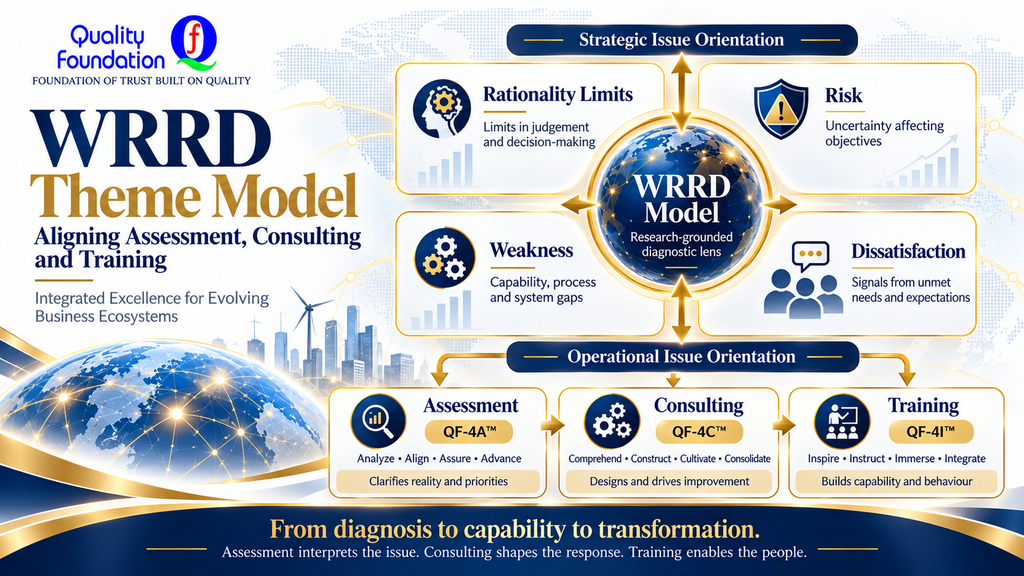
From Diagnosis to Capability to Transformation
Most organisations do not lack improvement initiatives. They struggle with something more fundamental: understanding the nature of the issue before deciding how to respond.
A recurring performance problem may look operational but originate in strategy. A customer complaint may appear isolated but reveal a wider system weakness. A risk may be recognised but poorly understood because decision makers are working with incomplete information, competing priorities or limited visibility. When the diagnosis is wrong, even good tools produce weak results.
The WRRD Model — Weakness, Rationality Limits, Risk and Dissatisfaction — provides the diagnostic foundation for Quality Foundation’s approach to Integrated Excellence. The model distinguishes between strategic issue orientation, represented by Rationality Limits and Risk, and operational issue orientation, represented by Weakness and Dissatisfaction. It then connects these issue orientations with proactive and reactive approaches that ultimately influence organisational performance.
Four lenses. One organisational reality.
Rationality Limits examine where judgement, information, assumptions or decision-making capability constrain the organisation’s ability to choose well.
Risk examines the uncertainty that can affect objectives — within the organisation, across the supply chain and throughout the wider business ecosystem.
Weakness identifies gaps in capability, processes, technology, systems and performance discipline.
Dissatisfaction captures the signals generated when customer, employee, supplier or stakeholder expectations are not adequately met.
These four dimensions are not intended to become another checklist. Their value lies in forcing management to ask a better question:
What exactly are we dealing with — and what kind of response does it require?
The research underlying the model found that Rationality Limits and Risk significantly influence proactive enablers, while Weakness and Dissatisfaction influence reactive enablers. Both proactive and reactive approaches, in turn, influence firm performance. The findings also show that risk can directly influence performance, reinforcing the need to treat risk as more than a compliance activity. f714610291112583
Turning insight into action
Quality Foundation connects the WRRD diagnostic lens with three complementary frameworks.
QF-4A™ — Assessment
Analyze → Align → Assure → Advance
Assessment begins by clarifying reality. It identifies which WRRD issues are present, examines their significance, tests the adequacy of existing controls and establishes the priorities for improvement.
The purpose is not simply to determine whether a requirement is being met. It is to determine what matters, why it matters and what should happen next.
QF-4C™ — Consulting
Comprehend → Construct → Cultivate → Consolidate
Consulting converts diagnosis into intervention.
Once the issue is understood, the appropriate response can be designed — whether that requires process redesign, Lean, TPM, Six Sigma, management-system strengthening, risk controls, sustainability improvement, technology integration or organisational development.
The principle is straightforward: the method follows the issue, not the other way around.
QF-4I™ — Training
Inspire → Instruct → Immerse → Integrate
No organisational intervention is sustainable unless people understand it, apply it and make it part of everyday work.
Training therefore moves beyond knowledge transfer. It builds the capability and behaviour required to support the response — from awareness and understanding to application, problem solving and integration into the workplace.
One connected approach to organisational excellence
Together, the models create a simple but powerful management logic:
WRRD identifies the issue.
QF-4A interprets and prioritises it.
QF-4C designs and drives the response.
QF-4I builds the capability to sustain it.
The result is a more disciplined path from diagnosis to action, from action to capability, and from capability to transformation.
This is the essence of Quality Foundation’s approach to Integrated Excellence for Evolving Business Ecosystems — connecting strategy, operations, people, risk and performance rather than treating them as separate programmes.
Assessment interprets the issue. Consulting shapes the response. Training enables the people. Performance is the outcome.
Research foundation
Roy, R., & Roychowdhury, S. (2025). Orientation-performance modelling for supply chain organisations ecosystem. International Journal of Business Performance and Supply Chain Modelling, 15(3), 281–314. https://doi.org/10.1504/IJBPSCM.2025.10070881
Make Excellence Sustainable
Bring QF-4C, QF-4I and QF-4A together to turn strategic intent into sustainable results.