Seeing Clearly. Advancing Confidently.
Effective improvement begins with a clear and evidence-based understanding of current reality. Quality Foundation’s assessment approach goes beyond checklist verification to examine how processes, controls, risks and results actually perform. Through the QF-4A™ Framework — Analyse, Align, Assure and Advance — we convert assessment into a structured improvement process. We analyse evidence to understand strengths, weaknesses, gaps and maturity. We align findings with organisational priorities, stakeholder expectations and management-system requirements. We assure whether existing controls are implemented and effective rather than merely documented. Assessment findings are translated into practical priorities for improvement and performance advancement. This creates greater confidence in management decisions and helps organisations focus resources where they can create the greatest impact. Clear evidence creates better decisions, and better decisions create stronger performance.
At Quality Foundation, assessment is not viewed as an exercise in finding gaps—it is a disciplined process for understanding organisational reality, verifying effectiveness and identifying where performance can be strengthened.
The QF-4A™ Framework — Analyse, Align, Assure and Advance — provides a structured, evidence-led approach to evaluate how well strategies, processes, controls, risks and results are connected. It moves assessment beyond compliance checking to create a clear view of current maturity, critical priorities and the actions required to build stronger, more sustainable performance.
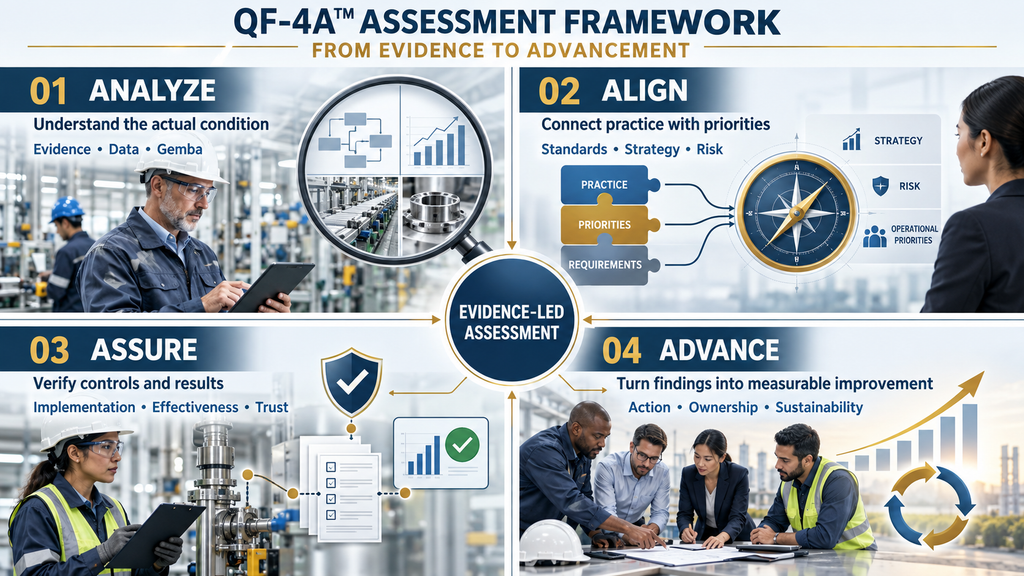
Analyse the reality. Align what matters. Assure what works. Advance performance. QF-4A™ is Quality Foundation’s evidence-led assessment framework for converting assessment from a checklist exercise into a structured cycle of assurance and measurable improvement. It evaluates whether requirements are defined, processes are implemented, controls are effective, risks are managed and intended results are achieved.
The framework applies to ISO management-system gap and readiness assessments, integrated management systems, process and operational maturity, Lean, TPM, Six Sigma, business excellence, supplier and value-chain performance, sustainability, ESG, energy, GHG, risk, resilience, ISMS, BCM, AI governance and compliance reviews.
The Assessment Lead owns planning, impartial evidence evaluation, finding validation and reporting; process owners provide evidence, confirm factual accuracy, analyse causes and implement actions; and top management prioritises high-risk findings, allocates resources and reviews progress. Assessment inputs include applicable standards, statutory and customer requirements, strategy, policies, objectives, KPIs, process maps, SOPs, responsibilities, operational controls, risk registers, HIRA, aspect-impact registers, FMEA, audit results, incidents, complaints, performance trends, previous findings and stakeholder expectations.
A1—ANALYZE: Establish the actual condition by defining scope and criteria, understanding context and process interactions, reviewing documents and data, observing work at the gemba, interviewing responsible personnel and tracing selected transactions from input to output. This stage identifies strengths, variations, bottlenecks, recurring losses, control weaknesses and unaddressed risks and produces the assessment plan, current-state profile, preliminary gap register and evidence record.
A2—ALIGN: Compare actual practices with standards, statutory obligations, customer requirements, strategic priorities, internal procedures and intended results. Examine whether objectives, KPIs, risks, resources and responsibilities support organisational direction; identify disconnects between policy, procedure, workplace practice and performance; and classify findings according to business impact, compliance exposure, operational risk and improvement potential. This produces the requirement-to-evidence matrix, confirmed findings, alignment map and management priority matrix.
A3—ASSURE: Verify whether controls are adequately designed, consistently implemented and effective across shifts, departments, products, projects and locations. Test controls through observation, interviews, record sampling, transaction tracing and data analysis; confirm KPI reliability, escalation arrangements and corrective-action effectiveness; and validate findings through documented evidence, workplace observation and demonstrated performance. This produces verified findings, control-effectiveness evaluation, maturity rating, critical-risk escalation and the executive assessment report.
A4—ADVANCE: Convert findings into responsible, measurable and sustainable action by prioritising statutory, customer, operational and business risks; assigning named owners, resources, target dates and completion criteria; requiring root-cause analysis for systemic or recurring issues; separating immediate correction from corrective action and system improvement; and establishing 30-, 60- and 90-day priorities with a longer-term maturity roadmap. Closure is accepted only after evidence and effectiveness verification, with significant findings incorporated into management review, risk registers, objectives, training and continual-improvement programmes. Every conclusion must be supported by at least two applicable evidence sources, including controlled documents, records, transaction samples, gemba observations, interviews, competence demonstrations, KPI trends, physical or digital traceability, incidents, complaints and demonstrated results. Opinion without evidence is not a finding; documentation without implementation is not assurance; and activity without results is not effectiveness.
Maturity is rated from Critical legal, safety, environmental, information-security or business-continuity exposure overrides the numerical score until adequately controlled.
Level 1—Reactive, Level 2—Defined, Level 3—Implemented, Level 4—Measured Level 5—Advanced.
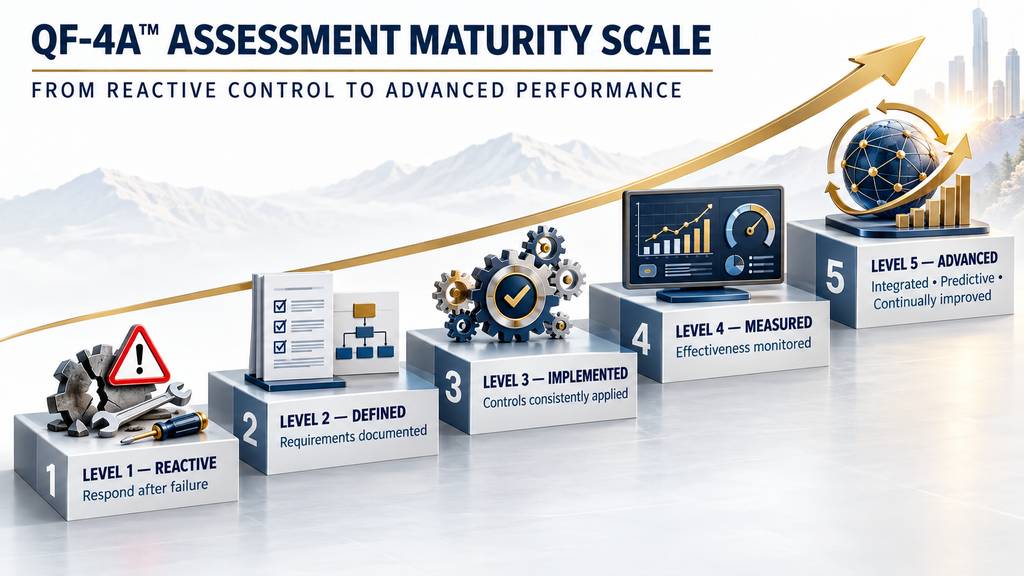
Findings are classified as Critical Exposure, Major System Gap, Control Weakness, Opportunity for Improvement or Strength/Good Practice. The completed assessment delivers an executive summary, evidence-based findings register, maturity profile, risk-priority matrix, replicable good practices, corrective-action roadmap, management decision points, follow-up plan and final assurance statement.
4A does not stop at identifying gaps—it converts evidence into insight, insight into assurance and assurance into sustainable performance.
Advance with confidence
Turn evidence into clarity, stronger controls and measurable progress across your management system.