The Evolution – From Reports to Intelligence
The journey from traditional management reporting to modern analytics mirrors the evolution of the industrial landscape itself:

In the modern economy, data is the new capital — an invisible yet decisive asset that drives every strategic decision.
Across industries, the ability to collect, analyze, and act on data defines competitiveness. This capability forms the essence of Business Data Analytics (BDA) and Business Intelligence (BI) — disciplines that transform raw information into insight, and insight into intelligent action.
BI and Analytics have evolved from simple reporting tools into strategic management systems that empower leaders to understand patterns, predict outcomes, and optimize operations in real time.
In an era shaped by Industry 4.0 and the emerging Industry 5.0, these disciplines have become the bridge between technology, people, and performance.
Business Intelligence refers to the processes, tools, and systems that convert data into meaningful information for decision-making.
Business Data Analytics takes this further — using advanced statistical, predictive, and AI-based techniques to uncover trends, forecast behavior, and recommend actions.
In simple terms, BI tells you what happened, while Analytics tells you why it happened and what might happen next.
Together, they enable organizations to:
Monitor performance through real-time dashboards.
Identify inefficiencies and hidden opportunities.
Predict customer needs, equipment failures, or market changes.
Support faster, evidence-based decision-making.
Integrate operational excellence with digital intelligence.
From manufacturing and logistics to healthcare, retail, and IT — every sector now depends on data as the foundation of improvement and innovation.
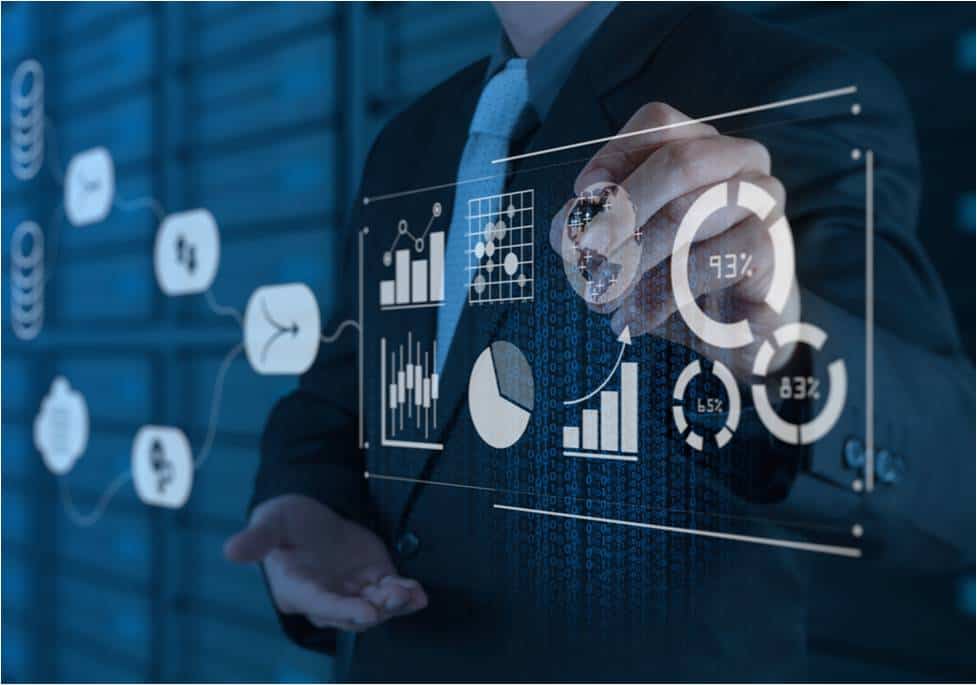
The journey from traditional management reporting to modern analytics mirrors the evolution of the industrial landscape itself:
| Era | Focus | Capability | Key Technologies |
|---|---|---|---|
| Industry 3.0 | Automation | Process control and data recording | PLCs, sensors, ERP |
| Industry 4.0 | Digitalization | Integration of systems and analytics | IoT, cloud, big data, AI |
| Industry 5.0 | Human–machine collaboration | Intelligence + purpose-driven innovation | Cognitive AI, digital twins, sustainability analytics |
Today, organizations move beyond descriptive analytics (“what happened”) to predictive and prescriptive analytics (“what will happen” and “what should we do”).
This transition marks the shift from data collection to data-driven culture, where insights are embedded into everyday workflows, not limited to specialized teams.
This layered approach creates a closed feedback loop, where data continuously improves both operational and strategic outcomes.
Business Analytics and BI are the nervous system of Industry 4.0 — connecting cyber-physical systems, IoT sensors, robotics, and cloud platforms into a seamless information ecosystem.
Industry 4.0 focuses on automation, digitization, and real-time analytics through smart factories, connected devices, and data-driven supply chains.
Industry 5.0, the next frontier, adds human-centricity, resilience, and sustainability, emphasizing collaboration between AI systems and human creativity.
Within this landscape, AI-powered analytics drives:
These applications represent the fusion of technology, analytics, and purpose — where business excellence meets digital transformation.
Artificial Intelligence transforms BI and analytics from reactive to autonomous decision systems.
Through Machine Learning (ML) and Natural Language Processing (NLP), AI can:
Automation frameworks such as RPA (Robotic Process Automation), when combined with analytics, enable hyperautomation — where repetitive tasks are eliminated, freeing people to focus on value creation and strategic innovation.
This convergence of AI, analytics, and automation is redefining how organizations achieve quality, productivity, and sustainability simultaneously.
Across every sector, data analytics and BI shift organizations from reacting to problems toward anticipating and preventing them.
Ultimately, BI and Analytics drive organizational intelligence — connecting technology, people, and performance into a continuous improvement cycle.
At Quality Foundation, we help organizations build the bridge between operational excellence and digital intelligence.
Our consulting and training services in Business Analytics, BI, and Digital Transformation enable clients to:
Whether you are beginning your data transformation journey or expanding into AI and digital maturity, Quality Foundation ensures that analytics become a core capability, not just a technology.