
Excellence Is Woven, Not Installed
Different organisational strands are woven into one sustainable performance fabric.
Most organisations do not suffer from a shortage of improvement initiatives. They have ISO certifications, Lean projects, TPM boards, Six Sigma teams, sustainability programmes and training calendars. The real weakness is that these activities frequently operate as separate threads. Quality remains with QA, equipment reliability with Maintenance, efficiency with Production, safety with EHS and competence with HR. Each thread may be strong, but disconnected threads do not create organisational strength. Excellence must be woven by connecting strategy, management systems, processes, people, evidence and improvement into one operating fabric. Michael Porter distinguished operational effectiveness from strategy and argued that both are essential: strategy establishes direction and choices, while operational effectiveness continually improves how work is executed (Porter, 1996). A management system creates value when it translates that direction into process ownership, operational controls, risk-based decisions and measurable results. Excellence therefore cannot be purchased as software, installed as a certification or delegated to one department. It is progressively built into how the organisation thinks, decides and works.
Results Rise Only as High as the System Beneath Them
QMS is shown as the hidden structural architecture supporting visible performance.

Customers see product quality, delivery reliability, responsiveness and service. Management sees revenue, cost, productivity and business growth. These visible outcomes are supported by a largely invisible operating structure: clear responsibilities, capable people, defined process controls, reliable equipment, risk assessment, standardised work, accurate records, escalation mechanisms and disciplined corrective action. When this underlying structure is weak, performance becomes person-dependent and management spends its time firefighting. A functioning Quality Management System should make abnormalities visible before they become customer failures. At the Gemba, the evidence is practical: operators understand critical parameters; inspection status is traceable; changes are controlled; equipment deterioration is recognised; deviations are escalated; and corrective actions eliminate causes rather than completing forms. The real test of a QMS is not whether a procedure can be produced during an audit. It is whether the process remains controlled during pressure, change, absence, breakdown or increased demand. Documentation is part of that structure, but documentation alone is not assurance. Results rise sustainably only when leadership, processes, competence, controls and evidence form a dependable foundation beneath them.
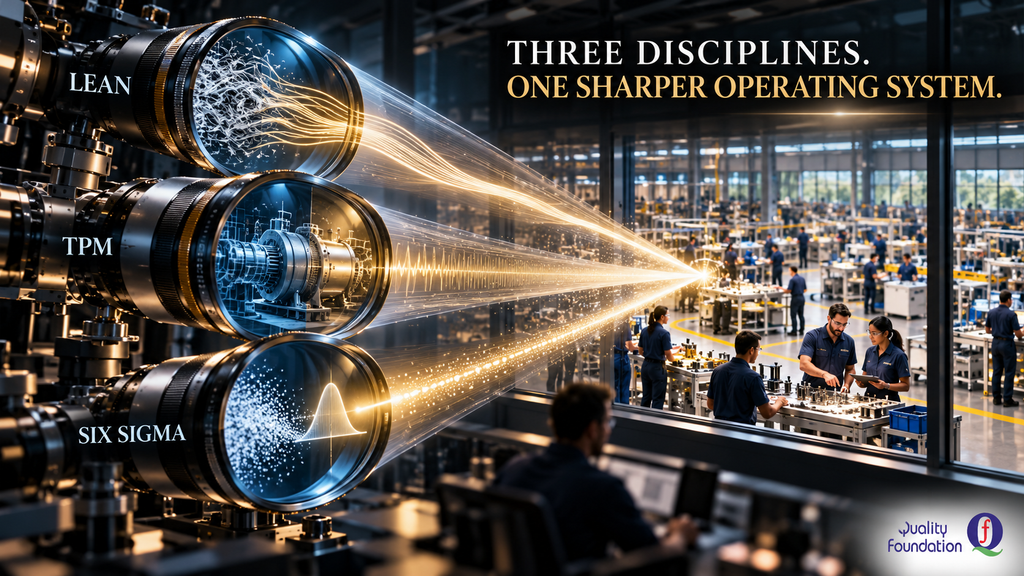
Three Disciplines. One Sharper Operating System.
Lean, Total Productive Maintenance and Six Sigma are not competing programmes. They are three different lenses through which an organisation can recognise loss. Lean sharpens the view of flow, delay, inventory, movement and non-value-adding work. TPM reveals equipment deterioration, minor stoppages, speed loss, defects and weaknesses in operator–maintenance ownership. Six Sigma exposes variation, instability, process capability and relationships between inputs and outcomes. Used separately, each method may deliver isolated gains. Used through an integrated QMS, they provide a much sharper understanding of the complete process. An unstable machine, for example, may simultaneously increase rejection, energy consumption, unsafe intervention, downtime, cost and delivery risk. It should not be addressed through six separate departmental actions. It requires one evidence-based problem-solving process with clear ownership and verified effectiveness. HBR research notes that organisations adopting similar operational-excellence practices can achieve very different outcomes because sustainable improvement depends on organisational capability—not merely the tools selected (Sunder and Linderman, 2026). The objective is not to run more improvement projects. It is to build an operating system capable of detecting loss early, solving it scientifically and preventing recurrence.
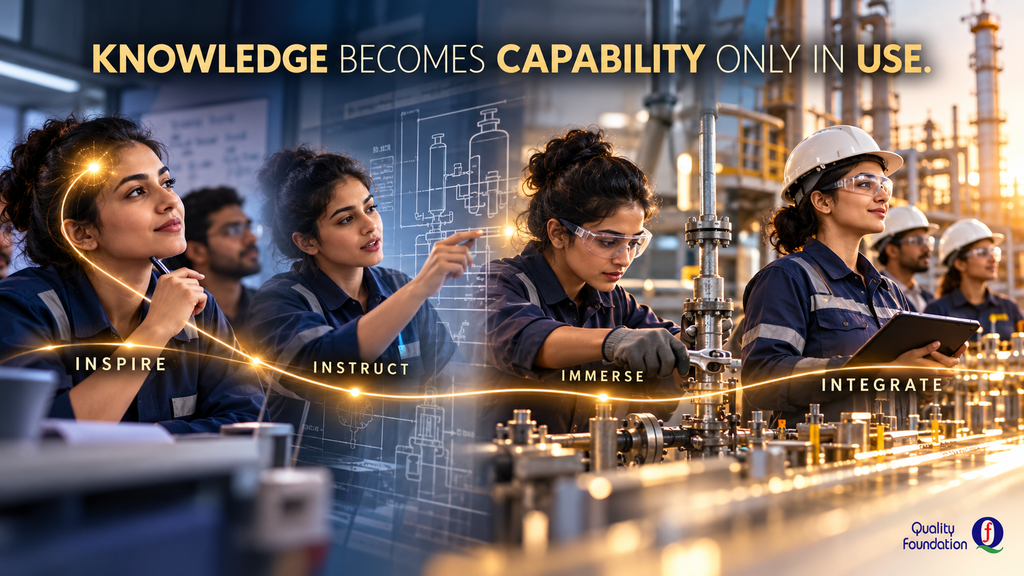
Block 4 — Knowledge Becomes Capability Only in Use
Training does not improve performance simply because employees attended a programme or passed a written test. Learning creates value only when people can apply it under actual workplace conditions. Research published in Harvard Business Review cautioned that training frequently fails because employees return to systems and leadership environments that do not support the expected behaviour (Beer, Finnström and Schrader, 2016). Capability building must therefore move from awareness to application. The QF-4I™ approach follows this progression: Inspire participants by connecting the subject with real operational challenges; Instruct them in the applicable concepts, standards and methods; Immerse them through cases, simulation, data analysis and hands-on practice; and Integrate the learning into standard work, responsibilities, controls and performance review. Zeynep Ton similarly demonstrates that investment in people produces stronger operational results when supported by standardisation, empowerment, simplification and cross-training (Ton, 2017). Training effectiveness should therefore be verified through demonstrated competence, changed behaviour, application evidence and improvement in relevant KPIs—not attendance records alone. Knowledge becomes organisational capability only when it changes how work is performed.
Block 5 — Excellence Is Balance in Motion
Integrated Excellence is not a static condition. Organisations continuously face changing customer expectations, technology, regulations, workforce capability, supply-chain disruption and resource constraints. Quality, safety, environment, energy, information security, sustainability and business continuity must therefore remain dynamically balanced. A production decision may improve output while increasing energy use, maintenance risk or safety exposure. A digital solution may improve speed but introduce information-security and continuity risks. Management must understand these interactions before optimising one result at the expense of another. Kaplan and Norton showed that performance measures influence managerial and employee behaviour and that financial results alone cannot adequately guide capability building and continual improvement (Kaplan and Norton, 1992). A balanced operating framework should connect Productivity, Quality, Cost, Delivery, Safety, Morale and Environment—PQCDSME—with risk, sustainability and stakeholder expectations. This balance requires leadership attention, trustworthy data, process-owner accountability and regular management review. Integrated Excellence is therefore not the elimination of movement or uncertainty. It is the organisational capability to remain controlled, responsive and purposeful while conditions continue to change. Quality is not what an organisation prepares for an audit; it is how the organisation sustains balance, learns from evidence and improves every day.

References
Porter, M. E. (1996). What Is Strategy? Harvard Business Review.
Sunder, V. M., and Linderman, K. (2026). 4 Capabilities That Drive Operational Improvement. Harvard Business Review.
Beer, M., Finnström, M., and Schrader, D. (2016). Why Leadership Training Fails—and What to Do About It. Harvard Business Review.
Ton, Z. (2017). The Case for Good Jobs. Harvard Business Review.
Kaplan, R. S., and Norton, D. P. (1992). The Balanced Scorecard—Measures That Drive Performance. Harvard Business Review.