Impact of AI on Society and Work | Quality Foundation
Meta Description: Discover how Artificial Intelligence is transforming society, jobs, manufacturing, business excellence, sustainability and decision-making, and why responsible AI governance matters.
Focus Keyphrase: Impact of AI on Society and Work
Suggested URL: /impact-of-ai-on-society-and-work/
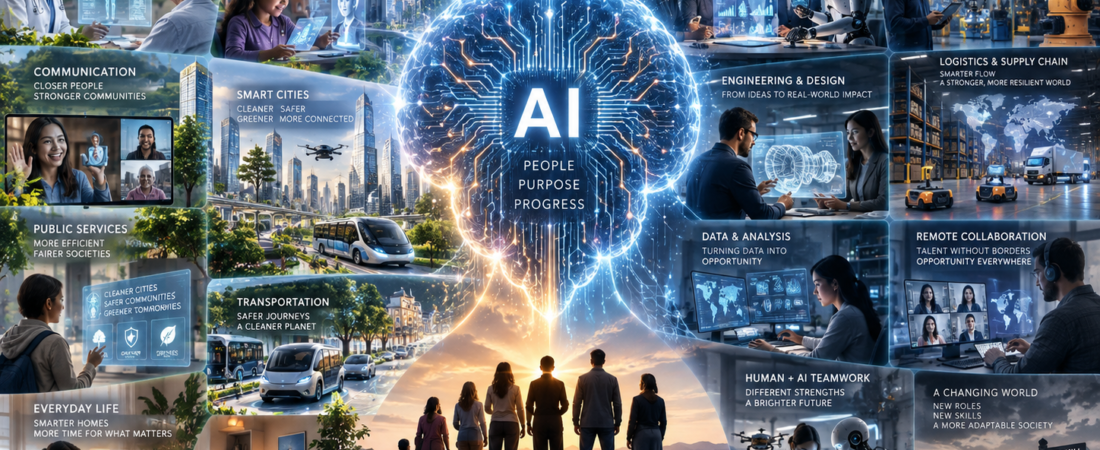
Artificial Intelligence is no longer just a technology trend. It is rapidly changing the way people live, learn, work, communicate, manufacture, analyse information and make decisions. The real impact of AI on society and work lies not simply in automation, but in how effectively organisations integrate people, processes, technology, governance and purpose.
AI and Society
Artificial Intelligence is already influencing healthcare, education, transportation, communication, public services and everyday life. In healthcare, AI can support faster diagnostics, medical-image analysis, patient monitoring and clinical decision support. In education, AI enables personalised learning, adaptive content and faster access to knowledge. Smart cities are using data, sensors and AI to improve traffic management, energy utilisation, waste management and public services.
The objective, however, should not be technology for its own sake. AI should contribute to better quality of life, safer communities, improved accessibility, sustainable development and informed decision-making.
AI and the Future of Work
The future of work is not simply about humans being replaced by machines. In many organisations, jobs will change before they disappear. Routine analysis, repetitive documentation, data consolidation and information retrieval are increasingly suitable for AI assistance, while judgement, leadership, creativity, negotiation, empathy and accountability remain strongly human.
The emerging model is therefore:
Human Capability + Artificial Intelligence + Process Discipline = Higher Organisational Performance
AI can help employees analyse information faster, identify patterns, evaluate alternatives and focus more time on higher-value work.
AI in Manufacturing and Operational Excellence
Artificial Intelligence has major potential in manufacturing and operational excellence. AI can support production scheduling, predictive maintenance, defect detection, process optimisation, energy analysis, supply-chain planning and demand forecasting.
In maintenance, AI-supported condition monitoring can help organisations move from Breakdown Maintenance → Preventive Maintenance → Predictive Maintenance. In quality management, AI can support defect analysis, variation monitoring, root-cause identification and predictive quality. In supply chains, it can improve inventory planning, logistics optimisation and supplier-risk monitoring.
For organisations practising Lean, TPM and Six Sigma, AI can become a powerful improvement enabler by identifying waste, abnormalities, variation and recurring losses faster.
AI and Integrated Business Excellence
The real opportunity emerges when AI is integrated with established management systems such as ISO 9001, ISO 14001, ISO 45001, ISO 50001, ISO/IEC 27001, ISO 22301, Lean, TPM, Six Sigma and EFQM.
AI can support customer-complaint analysis, environmental-performance monitoring, safety trend analysis, energy optimisation, cybersecurity monitoring, business-continuity planning and management decision-making. This creates a new pathway toward Integrated Excellence, where technology supports quality, safety, sustainability, resilience and business performance simultaneously.
AI Governance Is Essential
AI also introduces significant risks. Incorrect outputs, poor-quality data, privacy breaches, cybersecurity threats, algorithmic bias, intellectual-property leakage and excessive dependence on automated decisions can affect organisational performance and reputation.
Responsible AI therefore requires clear governance covering:
Purpose → Data → Validation → Decision → Human Oversight → Monitoring → Accountability
Frameworks such as ISO/IEC 42001 Artificial Intelligence Management System provide organisations with a structured approach to responsible AI governance. Management must clearly define who owns the AI application, what data it uses, how its output is validated, which decisions require human approval and how performance is monitored.
AI Cannot Fix a Poor Process
A fundamental principle of Lean and quality management remains valid in the AI era:
Digitising waste does not eliminate waste.
If a process has unclear responsibilities, poor data, weak controls or unreliable KPIs, AI may simply automate existing weaknesses. Organisations should first understand the process, map the workflow, identify risks and waste, establish reliable data, define controls and determine performance measures. Technology should then be introduced to strengthen the process.
AI-Enabled PDCA
Artificial Intelligence can strengthen the Plan–Do–Check–Act cycle. During Plan, AI can support forecasting, risk assessment and scenario analysis. During Do, it can support execution and intelligent workflows. During Check, it can analyse trends, deviations and performance data. During Act, it can support root-cause analysis and improvement prioritisation.
AI can accelerate PDCA, but leadership and accountability must remain human.
The Human Side of AI
The future will require employees who combine domain expertise with digital capability. A production engineer using AI-supported analytics, a quality professional applying AI to process data, or a maintenance engineer using predictive intelligence can become significantly more effective.
The future capability model is:
Domain Expertise × Digital Capability × Analytical Thinking × Human Judgement
Therefore, organisations must invest not only in AI tools but also in reskilling, competency development and change management.
Leadership in the AI Era
Leadership must ensure that AI creates measurable business value. The question should not be, “How much AI are we using?” It should be, “What measurable improvement is AI creating in quality, productivity, safety, sustainability, customer experience and organisational resilience?”
AI adoption must be connected with strategy, governance, performance indicators and continuous improvement.
Quality Foundation Perspective
At Quality Foundation, we see the future of organisational excellence as the convergence of:
Management Systems + Operational Excellence + Sustainability + Digitalisation + Artificial Intelligence + Human Capability
AI should not replace management systems, process discipline or human judgement. It should strengthen them.
The organisations that use AI responsibly will be able to become more productive, reliable, sustainable, resilient, data-driven and customer-focused.
The Future Is Human + AI
Artificial Intelligence will continue to reshape society and the workplace. Roles will evolve, new capabilities will emerge and decision-making will become faster and increasingly data-driven. Yet one principle should remain unchanged:
Technology amplifies human potential. Humanity gives technology direction.
For organisations, the real competitive advantage will not come from using AI alone. It will come from integrating AI, people, processes and governance into a disciplined system of continuous improvement and business excellence.
Quality Foundation – Foundation of trust… built on quality.
www.qualityfoundation.in